
Introduction
Asset and wealth management firms don't run on one system anymore. A single trade might touch an OMS, an EMS, a portfolio accounting platform, a compliance engine, and three separate reporting layers before it ever reaches a client statement.
That complexity isn't shrinking. In Deloitte's 2024 Banking & Capital Markets Data and Analytics Survey, 88% of respondents said their data existed across different sources but was duplicated and never fully integrated. Firms are also feeling it in the budget: McKinsey estimates banks spend 6% to 12% of their annual technology budget on data alone.
Without visibility into where data originates and how it transforms along the way, incident resolution slows down, compliance exposure grows, and trust in AI-driven analytics erodes fast.
This guide compares the leading data lineage tools, breaks down what to look for, and outlines how investment management firms can select and implement the right one.
TL;DR
- Data lineage maps each data point from origin through transformations to destination—essential for compliance, troubleshooting, and trusted reporting
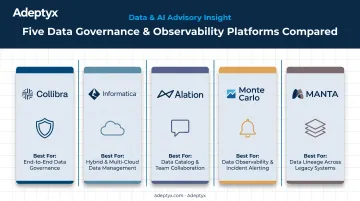
- Collibra, Informatica, Alation, Monte Carlo, and MANTA excel at different jobs—match the tool to your primary gap, not the brand
- Choose on integration breadth, automation depth, and compliance support—not UI polish
- Firms with legacy trading and portfolio stacks move faster with a partner who has mapped this terrain before
Overview of Data Lineage in Investment Management
Data lineage is the record of where a piece of data came from, what happened to it, and where it ended up. For asset and wealth managers, that record has to stay accurate across trading, portfolio management, and compliance systems. Auditors, regulators, and clients all eventually ask the same question: "how did you get this number?"
Lineage-tool adoption stats specific to financial services are scarce. Data fragmentation is still the norm, not the exception, and firms already pour heavy tech budget into data infrastructure. The open question is whether that spend buys visibility or just more storage.
In investment management, lineage pressure shows up most clearly when teams must:
- Defend a reported number to auditors or regulators with full provenance
- Trace a figure from source system through transforms into client or board reporting
- Keep that trail intact across layered, decades-deep system stacks

The tools below are the ones most relevant to organizations working under those conditions.
Top Data Lineage Tools Compared
We evaluated each tool on governance rigor, integration breadth, automation depth, compliance support, and enterprise scalability: the factors that matter most once a tool has to sit alongside a live OMS or portfolio accounting platform.
Collibra
Collibra built its reputation as an enterprise data governance and cataloging platform, and it's become a common sight in regulated industries, including financial services, where lineage needs to sit next to stewardship workflows rather than off in its own silo.
Collibra ties end-to-end lineage directly to automated compliance and approval workflows. Its own material describes this in the context of BCBS 239 compliance, where banks trace risk exposures back through transformations to source systems.
That workflow-plus-lineage mix suits firms managing regulatory reporting across trading and portfolio systems, where "who approved this change" matters as much as "where did this number come from."
| Criterion | Detail |
|---|---|
| Best For | Enterprises prioritizing governance, compliance, and workflow automation |
| Key Strengths | End-to-end lineage tracking, automated stewardship, audit trail generation |
| Integration Focus | Hybrid systems, data catalogs, cross-platform governance |
Informatica
Informatica has been in enterprise data management long enough to have built lineage capabilities that reach across nearly every environment a firm is likely to run: cloud, on-prem, or both at once.
AI-driven metadata scanning can extract lineage from SQL scripts, stored procedures, and even ML code, filling gaps where documentation never existed. That helps firms modernizing legacy OMS or portfolio accounting platforms where nobody left a data map behind.
Scanners cover databases, cloud warehouses, mainframes, Hadoop, Spark, Kafka, and BI tools, with a custom loader for proprietary or heavily modified systems.
| Criterion | Detail |
|---|---|
| Best For | Hybrid and multi-cloud data environments |
| Key Strengths | AI-driven catalog, automated scanning, broad platform support |
| Integration Focus | On-premises systems, cloud warehouses, legacy applications |
Alation
Alation's angle is different from the other governance-first platforms on this list: it's built for collaboration and discovery, aimed at business users just as much as data engineers.
Accessibility is the point. Alation layers annotations and shared context onto lineage and metadata, so a compliance analyst or portfolio manager doesn't need a data engineering background to see where a number came from.
Its Manta partnership added automated, column-level lineage and impact analysis on top of Alation's core table-to-table lineage, closing a gap that used to require a separate tool.
| Criterion | Detail |
|---|---|
| Best For | Teams prioritizing collaboration and data intelligence |
| Key Strengths | Strong catalog, easy discovery, business-user accessibility |
| Integration Focus | BI tools, data warehouses, collaborative governance workflows |
Monte Carlo
Monte Carlo comes from the data observability world, not traditional governance, and that shows in how it handles lineage. Instead of documenting lineage as a static map, it pairs automated field-level lineage with anomaly detection and incident alerting.
Monte Carlo's Field Lineage tracks column-level dependencies and separates direct relationships from ones created by filtering or ordering logic, which shortens root-cause analysis.
For firms running complex trading and portfolio data pipelines where a broken feed means a bad number on tomorrow's report, that speed matters more than catalog polish alone.
| Criterion | Detail |
|---|---|
| Best For | Teams needing real-time troubleshooting and observability |
| Key Strengths | Field-level lineage, anomaly detection, faster incident resolution |
| Integration Focus | Modern data stacks, cloud warehouses, BI platforms |
MANTA
MANTA (now IBM Manta Data Lineage) specializes in something modern-stack tools generally skip: deep, automated parsing of transformation logic across both legacy and current systems.
Scanners work across mainframes and legacy infrastructure most cloud-native tools can't parse, and MANTA pairs with governance platforms like Collibra and Alation rather than competing with them. IBM states it runs more than 40 automated scanners across hybrid and multicloud environments.
For firms with decades-old trading systems still doing real work, legacy visibility plus governance-platform pairing is often the deciding factor.
| Criterion | Detail |
|---|---|
| Best For | Businesses needing deep impact analysis across complex dependencies |
| Key Strengths | Cross-platform visibility, legacy system support, detailed mapping |
| Integration Focus | Legacy databases, ETL code, governance platform pairing |
How We Chose the Best Data Lineage Tools
The most common mistake firms make is picking the wrong tool for their architecture because a demo looked impressive. Brand recognition and slick visualizations don't tell you whether a tool can actually parse your custom-built OMS integration or your fifteen-year-old mainframe batch job.
We weighted five factors, and tied each one to a business outcome:
- Automation depth — less manual mapping means faster audits and fewer stale lineage maps
- Integration breadth — coverage across legacy and modern systems reduces blind spots that turn into operational risk
- Compliance/audit support — built-in workflows and audit trails shorten regulatory response time
- Scalability — a tool that works for 50 data sources today needs to still work at 500
- Ease of adoption — if only your most senior engineer can use it, adoption stalls
Firms without deep in-house data engineering resources often underestimate how much implementation work sits between "we bought the tool" and "the tool actually works." An advisor who has already mapped OMS, EMS, and portfolio accounting integrations can evaluate and implement lineage tooling without disrupting live trading and reporting. That implementation gap is where most in-house rollouts stall.
Conclusion
Choosing a data lineage tool comes down to fit with your existing architecture, your regulatory obligations, and where you're headed over the next few years. Brand recognition alone rarely predicts the right match.
Before committing, assess:
- Scalability against your data volume growth, not just current state
- Integration depth across your specific OMS, EMS, and accounting systems
- Total cost of ownership, including implementation and ongoing maintenance
- Pilot performance on one critical dataset before any full rollout
That last point matters more than firms tend to give it credit for. A tool that performs well in a vendor demo can behave very differently against your actual trading data.
For asset and wealth management firms navigating this decision, Adeptyx's embedded consultants use the firm's proprietary Next State methodology and four-phase Assess, Advise, Design, Deliver framework. They evaluate current data architecture and guide tool selection and implementation without pushing firms into unnecessary re-platforming of systems that are still doing their job.
Frequently Asked Questions
What is data lineage used for?
Data lineage supports troubleshooting when data errors surface, impact analysis before making system changes, and audit trails for regulatory compliance and governance reviews.
Can you provide an example of data lineage?
A portfolio value shown on a client dashboard can be traced back through a specific transformation step to its original source in an OMS or accounting platform — showing exactly where the number came from and what changed along the way.
What is the difference between data lineage and a data catalog?
A data catalog tells you what data exists and where it lives. Data lineage tells you where that data came from and what happened to it before it got there.
How do investment management firms choose the right data lineage tool?
Fit with existing OMS, EMS, and portfolio systems matters more than brand recognition. Automation depth, compliance support, and scalability should drive the decision.
Is data lineage required for regulatory compliance in financial services?
Not explicitly by name. SEC and FINRA books-and-records and audit expectations still demand clear data accountability, and lineage tools make those trails far easier to produce and defend.
What is the difference between open-source and enterprise-grade data lineage tools?
Open-source tools like OpenLineage are cost-effective but require in-house technical expertise to deploy and maintain. Enterprise tools cost more but bring vendor support, automation, and security built for regulated environments.