
A staggering 70% of digital transformations at financial institutions exceed their original budgets, and only 30% of banks that attempt one successfully execute their strategy, according to McKinsey research on digital banking transformations. A major reason: business leaders and technology teams plan separately, then try to reconcile their work too late.
Many leaders also conflate "management consulting" with "technology consulting," which makes it harder to know which type of help they actually need. This guide breaks down both disciplines, the services they cover, warning signs your firm needs outside help, and how to pick the right partner.
Key Takeaways
- Management and technology consulting now overlap constantly inside asset management firms
- Legacy platforms and siloed data remain the top triggers for outside consulting support
- Firms with $250B+ AUM cite fragmented systems as core transformation barriers
- Embedded models that transfer knowledge outperform report-and-leave engagements
- Assess-advise-design-deliver methodology lowers risk on multi-year tech programs
What Is Management and Technology Consulting?
The phrase gets used loosely. Understanding the distinction matters, especially before you sign a statement of work.
Management Consulting Defined
Management consulting is process-oriented. It diagnoses organizational inefficiencies, redesigns workflows, and improves strategic and operational performance across finance, operations, and people management.
The Institute of Management Consultants USA defines it as providing objective advice on an organization's strategy, structure, management, and operations, in pursuit of long-term objectives. That advice can range from identifying options to actually implementing the solution.
Technology Consulting Defined
Technology consulting identifies, implements, and optimizes the technology needed to support business objectives. That includes software, data platforms, infrastructure, and cybersecurity.
Gartner frames this category as project-based work that creates "the ambition and design for clients' information, technology, and business processes." Information, technology, and business initiatives are now interdependent rather than stacked in separate layers.
Why These Disciplines Are Converging in Financial Services
In asset and wealth management, this convergence isn't theoretical. A trading desk redesign is a strategic decision. An OMS modernization is a technology execution. Try to separate them, and you'll end up rebuilding the same workflow twice.
McKinsey's guidance on building the tech backbone for asset management connects a five-year business footprint to technology ambition, target architecture, and an implementation roadmap. Strategy and execution sit in one continuous plan, not a handoff between departments.
Adeptyx has seen this firsthand. In one engagement, a top U.S. retail broker needed to replace an on-premises OMS and a hosted vendor solution at the same time. The work shipped as one coordinated architecture, not a stack of sequential IT tickets:
- Custom low-latency FIX engine
- CAT and EBS reporting with independent data validation
- Cross-market connectivity across the U.S. and Canada

Asset managers, wealth firms, and broker-dealers increasingly want one partner who bridges both disciplines, instead of coordinating a management consultancy and a separate IT vendor.
Key Services Offered by Management and Technology Consulting Firms
Firms at the intersection of strategy and systems typically cover a defined set of services:
- Strategic technology planning that aligns IT investment with long-term business goals
- Data management and governance, including a unified golden-copy model across OMS, accounting, compliance, and reporting
- Systems selection and implementation for platforms such as OMS, EMS, and portfolio accounting—without forcing a full re-platform when it is not needed
- Compliance and regulatory reporting support for frameworks like CAT and SEC Rule 606
- Program and project management that keeps multi-year transformations on schedule
- Process redesign across the front-to-back value chain, from trading through client reporting
Adeptyx delivers much of this work through its four-phase Next State methodology:
- Define the data or business vision
- Assess current systems and gaps
- Design the target architecture
- Validate and execute via proof-of-concept before full rollout
The aim is incremental modernization that limits operational disruption.
That same approach shows up in tax-aware portfolio work. For one global investment advisor, Adeptyx added tax-loss harvesting, built rebalancing at scale, and rolled out new OMS and portfolio-optimizer technology across multiple regions.
Signs Your Organization May Need a Consulting Partner
Not every firm needs outside help. But certain patterns are strong indicators that internal teams are stretched past their capacity.
Legacy Systems and Manual Workarounds
When data can't flow cleanly across OMS, accounting, compliance, and reporting environments, teams compensate with spreadsheets and email chains. This creates:
- Conflicting security identifiers across systems
- Unclear data ownership between teams
- Manual exception handling that slows reconciliation and reporting
- Blocked adoption of AI tools and real-time analytics that depend on clean, governed data
Business Growth Outpacing Infrastructure
Certain triggers reliably outpace what existing technology can support. Global alternatives AUM alone is projected to rise from $16.8 trillion at the end of 2023 to $29.2 trillion by 2029, according to Preqin's Future of Alternatives forecast.
- Entry into alternative investments requires new workflows, clean data, and integration across legacy systems that weren't built for them.
- M&A activity usually means merging two tech stacks, two data models, and two compliance regimes at once.
- Rapid AUM growth strains systems built for a $5B firm once operational demand hits $50B scale.

Compliance Complexity Outstripping Internal Bandwidth
Regulatory reporting requirements, including CAT and Rule 606, demand precise, auditable data. When internal teams are already running day-to-day operations, adding regulatory complexity on top often means something gets deprioritized. That's a risk most firms can't afford to take.
How to Choose the Right Management and Technology Consulting Firm
Not all consulting partners are built the same way. A few criteria separate firms that deliver lasting value from those that only produce a slide deck.
Prioritize domain expertise over generalist breadth. A firm that already understands OMS workflows, compliance rules, and the nuances of security master data will move faster and recommend more relevant solutions than a generalist consultancy learning the industry on your dime.
Look for embedded delivery, not report-and-leave. Some firms hand over a strategy document and walk away. Others integrate senior consultants directly with your trading, technology, and compliance teams to accelerate delivery and transfer knowledge along the way. Adeptyx uses this embedded model with asset and wealth management firms across the full investment value chain — consultants work alongside internal staff rather than delivering recommendations from the outside.
Check the track record against your scale and complexity. Ask for references from engagements of comparable size and scope. Relevant proof points look like this:
- 45+ asset managers served, from $5 billion to more than $10 trillion in AUM
- Wealth management implementations touching millions of client accounts
- Multi-year delivery cited by leadership at a $120 billion AUM firm
Confirm a structured methodology exists. A repeatable framework — assess, advise, design, and deliver — reduces risk and improves predictability. Ask what's actually produced at each phase:
| Phase | Typical Output |
|---|---|
| Assess | Current-state findings, gap analysis, prioritized recommendations |
| Advise | Technology roadmap, business case, RFP management |
| Design | Detailed requirements, configured systems, test validation |
| Deliver | Implementation, training, change management, go-live support |
If a firm cannot show clear outputs by phase, expect more ad hoc delivery and less predictable outcomes.
Business Impact: Benefits of Management and Technology Consulting
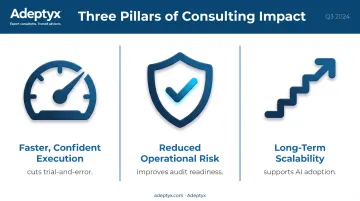
Outside expertise shows up in three places that matter: execution speed, risk reduction, and long-term flexibility.
Faster, more confident execution. Specialized expertise cuts trial-and-error on strategic initiatives. Digital transformations often slip budget and timeline without that guidance, so the speed advantage compounds over a multi-year program.
Reduced operational risk. Stronger data governance and modernized systems improve audit readiness. Adeptyx engagements have delivered that in practice:
- Consolidating fragmented feeds into a governed "golden copy" mapped across OMS, accounting, compliance, and reporting improved enterprise-wide transparency
- Pairing a custom FIX engine with CAT and EBS reporting controls improved regulatory alignment without disrupting production trading
Long-term scalability. Firms that build a governed data foundation around their actual roadmap—not isolated upgrades—set up AI adoption and real-time decisions. They also avoid repeating the same disruptive re-platforming cycle every few years.
Frequently Asked Questions
What does a technology consultant do?
A technology consultant assesses an organization's systems and technology needs, then designs and implements solutions across software, data, and infrastructure. They also help resolve system-related problems as they arise during and after implementation.
What is the difference between management consulting and technology consulting?
Management consulting addresses organizational strategy and process improvement. Technology consulting focuses on the systems and tools that support those improvements. The two increasingly run as one initiative rather than separate workstreams.
Which industries benefit most from combined management and technology consulting?
Investment and wealth management firms gain the most when strategy and systems are addressed together. Regulatory complexity and legacy platforms make it costly to treat those as separate problems.
How long does a typical consulting engagement take?
Engagement length varies widely based on scope. An assessment might take a few weeks, while a full system modernization program can run for multiple years.
What is an embedded consulting model?
Embedded consultants work directly alongside internal teams rather than delivering recommendations from the outside. This structure improves delivery speed and helps internal staff retain practical knowledge after the engagement ends.
How much does management and technology consulting typically cost?
Costs vary based on project scope, consultant seniority, and engagement length. Expect a tailored proposal built around your systems, data condition, and regulatory requirements rather than a fixed package price.