

Search for "product service management," though, and you'll find two different conversations happening at once. One camp uses it to describe managing bundled product-and-service offerings. The other applies product management discipline to service-based businesses entirely. Both readings are legitimate, and both matter, especially for firms navigating the shift from one-time software license to managed platform.
This guide clarifies both. We'll define the term, distinguish it from traditional product management and the Product Owner role, walk through core responsibilities and lifecycle frameworks, and show how the discipline plays out in complex environments like investment and wealth management.
Key Takeaways
- Product service management unites product development and service delivery across the full offering lifecycle
- It differs from product management and the Product Owner role, though the three often blur in services firms
- No universal framework exists—most firms use a lifecycle model from ideation through retirement
- Financial services firms need it now as trading, data, and portfolio platforms move to managed, subscription delivery
What Is Product Service Management?
Product service management is the discipline of managing a product and the service built around it, tangible or not, as one coordinated offering across its full lifecycle. Instead of treating "the product" and "the service that wraps around it" as two separately owned pieces, one person or team owns both.
That's also the answer to a related question: what is product management for services? In consulting firms, SaaS-plus-services businesses, and financial services organizations, the same toolkit product managers use for physical goods—market research, roadmapping, pricing, lifecycle oversight—gets applied to offerings that are intangible or hybrid.
The Wikipedia entry on service product management draws on functions often attributed to product management author Linda Gorchels. A service product manager's core job is to spot a profitable service opportunity and "productize" it: documenting scope, defining pricing, and giving it the same structure a physical product line would get.
Core Components of Product Service Management
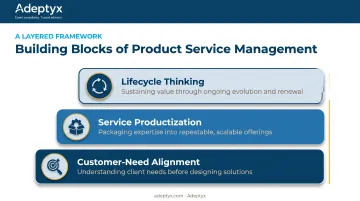
Three things separate this discipline from simply "selling a product with support attached":
- Customer-need alignment — continuously mapping what clients need and how those needs shift over the relationship, not just at the point of sale
- Service productization — turning ad-hoc, bespoke delivery into something repeatable: packaged, scoped, and priced
- Lifecycle thinking — overseeing the offering from initial concept through active management to eventual retirement, rather than losing focus after launch
These build on each other. You can't productize a service until you understand the need behind it, and you can't manage a lifecycle without a productized offering to manage in the first place.
Why It Matters for Financial and Professional Services Firms
Platforms once sold as one-time software licenses, such as order management systems (OMS), portfolio accounting tools, and data platforms, are increasingly delivered as ongoing managed services. That shift changes what "finished" looks like. A license sale ends at delivery. A managed service doesn't end; it needs the same rigor product managers apply to any product line: usage data, renewal risk, roadmap prioritization, and tiered pricing.
The broader enterprise software market backs this up. Gartner forecasted worldwide cloud application services (SaaS) spending to grow 20% to $247.2 billion in 2024, signaling that subscription-style, continuously managed delivery is becoming the default across enterprise technology.
For asset managers, wealth managers, and broker-dealers, that trend creates a few practical realities:
- Trading, data, and portfolio platforms need ongoing coordination between technology and operations teams—not a single go-live moment
- Internal platform teams must manage adoption, satisfaction, and renewal the way a product line owner would
- Firms without a clear owner for the "product-plus-service" offering often face fragmented decisions between IT and the business
Product service management gives those firms one discipline for ownership, prioritization, and renewal.
Product Service Management vs. Product Management vs. Product Owner
These three terms get tangled together constantly, and it's easy to see why. Inside a services organization, one person often wears all three hats: setting strategy, managing the backlog, and fielding client escalations, sometimes in the same week.
Product Management vs. Product Service Management
Traditional product management centers on the product itself: features, development cycles, and launch. Product service management widens that lens to include delivery capability, support infrastructure, and the value a client experiences long after the sale.
| Dimension | Traditional Product Management | Product Service Management |
|---|---|---|
| Primary focus | Features and development | Product plus delivery, support, and post-sale value |
| Commercial model | Transactional sales | Subscriptions and ongoing relationships |
| Customer relationship | Launch and feedback cycles | Continuous relationship management |
| Success metrics | Adoption rates, feature usage | Retention, satisfaction, recurring revenue |
| Lifecycle view | Discrete product with a fixed feature set | Concept through eventual retirement |
The right approach depends on the business model. Traditional product management suits discrete, transactional products—think a standalone tool sold per license. Product service management fits subscription, B2B, and relationship-driven models, where the sale marks the start of the relationship rather than the end.
Product Owner vs. Product Manager in a Services Context
This is one of the most frequently asked questions in the space, and Product School's comparison of the two roles makes the distinction fairly clean:
- Product Owner (PO): tactical, backlog-focused. Works inside the development team to decide what gets built next, sprint by sprint.
- Product Manager (PM): strategic, lifecycle-focused. Owns market positioning, pricing direction, and the offering's trajectory over time.
In smaller or leaner services organizations, especially boutique financial technology teams, these roles frequently collapse into one person. That's a major source of the confusion around "product service management" as a term. The person doing the work is setting strategy and grooming the backlog simultaneously, without a clean split of duties.
Picture a portfolio platform team supporting an asset manager's OMS integration. The PM decides which client segments to prioritize and how pricing should evolve as the platform adds data feeds. The PO translates that direction into sprint-level tasks: fixing a reconciliation bug, adding a report field, testing a FIX connectivity update. Both roles matter. Neither replaces the other.
Key Responsibilities of a Product Service Manager
The responsibilities span the entire customer journey, not just launch day and go-live.
Core responsibilities typically include:
- Customer needs analysis — Map client journeys, surface service pain points, and link product usage to service demand (for example, a trading-volume spike often means more support capacity, not just more infrastructure)
- Service productization and packaging — Turn raw ideas into sellable offerings with a clear scope, technical specs, and pricing so one-off work becomes a repeatable roadmap item
- Pricing and profitability management — Estimate true resource cost, balance demand against delivery capacity, and set tiers that reflect both product value and service delivery cost
- Performance monitoring and optimization — Track product usage alongside service-quality metrics (resolution time, client satisfaction) and feed findings back into the roadmap
- Full lifecycle and ramp-down management — Coordinate upgrades, replacements, and retirements so sunsetting an offering does not disrupt existing clients

Lifecycle and ramp-down work is often the most neglected. Firms invest heavily at launch, coast through the middle years, then scramble when it is time to retire something cleanly.
Frameworks, Lifecycle Stages, and Benefits of Product Service Management
There's no single industry-standard framework for product service management. That flexibility is part of how the discipline works. Most organizations lean on one of two approaches: a stage-based lifecycle model, or an adapted strategic-analysis framework.
One example borrowed from marketing strategy is the "5 C's": Company, Customers, Competitors, Collaborators, and Context, applied to service productization instead of a standalone campaign. It's a useful lens for situational analysis, but it isn't a formally recognized product-service lifecycle standard. Treat it as one tool among several.
Common Lifecycle Stages
Most lifecycle-based approaches compress into four broad stages, though organizations expand or collapse them depending on complexity:
- Strategic development — defining the opportunity, target client, and business case before building anything
- Active management and launch — bringing the offering to market and onboarding the first clients
- Continuous optimization — refining pricing, scope, and delivery based on real usage and feedback
- Smart discontinuation — retiring or replacing the offering with minimal disruption to existing clients
Core Benefits of the Approach
Coordinating product and service under one owner produces a few consistent advantages:
- Higher retention from a coordinated, single-vendor experience instead of fragmented handoffs between product and support
- Stronger operational efficiency through shared roadmaps and fewer duplicated efforts across departments
- Diversified revenue, since a well-productized service can be priced and sold on its own
There's a broader dynamic at play in services-heavy sectors: every additional service a client takes on increases stickiness and opens new revenue. The real payoff is becoming harder to leave.
Applying Product Service Management in Investment and Wealth Management
Asset and wealth managers face a specific version of the product-plus-service challenge. Trading systems (OMS/EMS), data platforms, and portfolio tools are increasingly delivered and consumed as ongoing managed services rather than one-time implementations. That shift means technology and operations teams need the same disciplined coordination a product service manager would bring to any subscription business.
Adeptyx approaches this through an embedded consulting model: consultants work directly inside client technology, trading, operations, and compliance teams rather than delivering advice from the sidelines. Its four-phase framework structures that work:
- Assess — map the value chain or problem, benchmark against industry practice, and flag gaps
- Advise — align technology and data roadmaps with strategy, including build-versus-buy and business cases
- Design — turn strategy into requirements, workflows, and system configurations
- Deliver — run implementation through go-live with change management, training, and risk controls

That work is guided by Adeptyx's proprietary Next State methodology, built to modernize OMS and data ecosystems without disrupting daily trading or operations. Teams define a data vision, assess the current state, and design a target architecture—including a unified "golden copy" data model. They then validate that architecture through proof-of-concept testing before rollout.
In one engagement, a leading investment manager used this approach to modernize its enterprise data architecture. The team consolidated multiple data feeds into a single golden copy, mapped integrations across OMS, accounting, compliance, and reporting, and set clear data ownership and governance.
The result was a more scalable, transparent platform that supported faster product launches and real-time reporting across trading and compliance. Adeptyx has applied the same discipline with more than 45 asset managers, from boutique firms to institutions managing over $10 trillion in assets.
That level of coordination needs deliberate ownership. A practical starting point for any firm:
- Assign clear ownership over the product-plus-service offering, someone accountable for both the platform and how it's delivered
- Align technology and operations roadmaps so neither team is optimizing in isolation
- Tie every enhancement back to measurable client value, not just technical completeness
Frequently Asked Questions
What is product management for services?
It's the practice of applying product management disciplines (market research, roadmapping, pricing, and lifecycle oversight) to intangible or hybrid service offerings instead of physical products. The goal is a repeatable, profitable, well-managed offering.
What's the difference between a Product Owner (PO) and a Product Manager (PM) in product management for services?
The PO handles tactical backlog management and sprint-level execution within a delivery team. The PM owns strategy, market positioning, and the offering's full lifecycle. In smaller service organizations, these often merge into one role.
What are the common frameworks or stages in product management for services?
There's no single standard. Most firms use a lifecycle-stage model running from ideation to retirement, or adapt strategic frameworks like the 5 C's (Company, Customers, Competitors, Collaborators, Context) for service productization.
What does a service product manager do?
They identify profitable, repeatable service opportunities, package them into documented, priced offerings, and manage them through their full lifecycle, from initial concept to eventual retirement.
What is a real-life example of product service management?
Enterprise software bundled with support, training, upgrade rights, and deployment assistance is a common example. The license isn't sold as a standalone transaction but as part of an ongoing managed relationship.
How does product service management differ from traditional product management?
It takes a broader, cross-functional view spanning delivery, support, and long-term client relationships. Traditional product management focuses more narrowly on feature development and launch cycles.